

The Remodel Trap: Nearly the Cost of New, Half the Value.
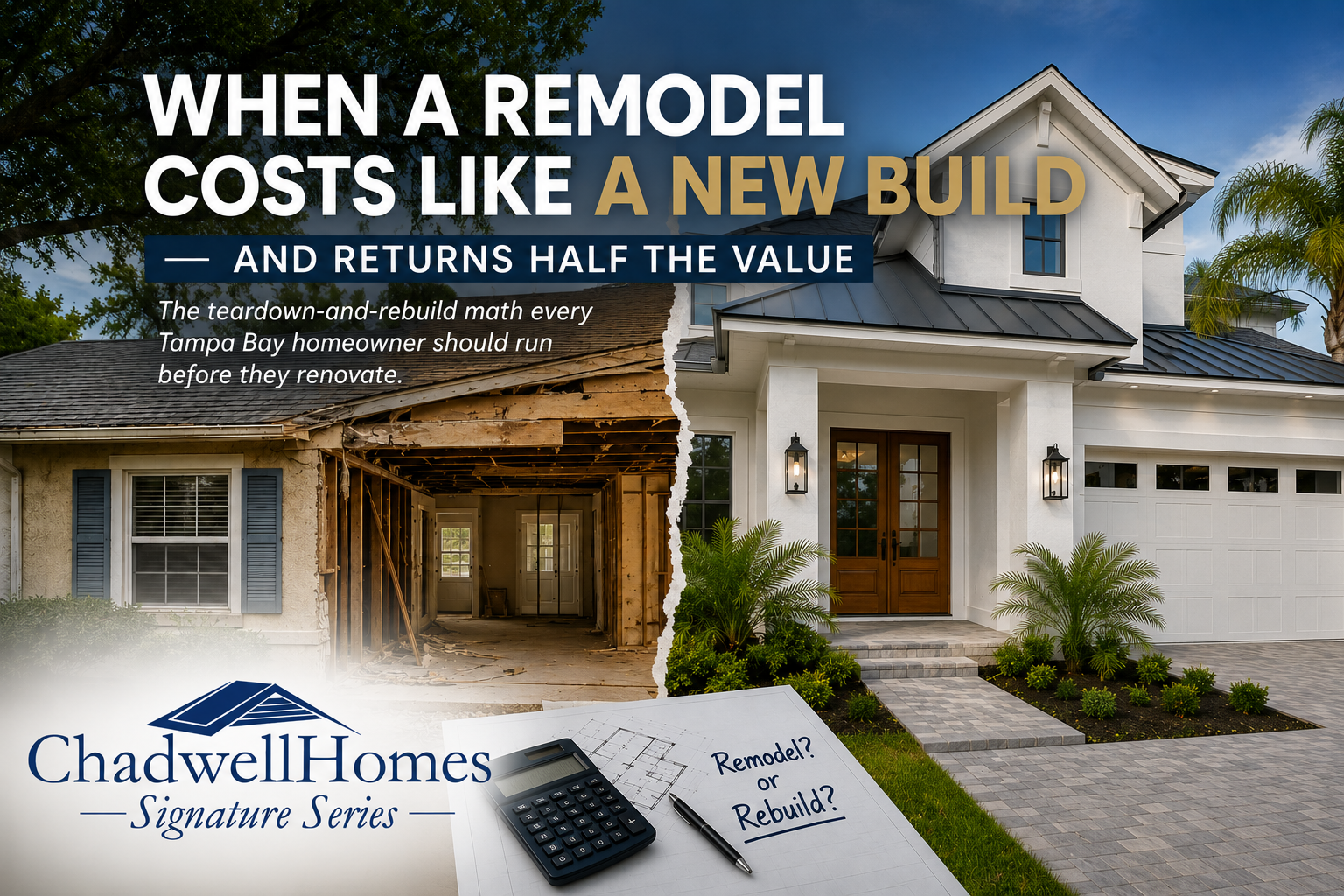
The teardown-and-rebuild math every Tampa Bay homeowner should run before they renovate.
You love your street. The neighborhood, the mature oaks, the lot, the schools, the short drive to everything that matters to your family — all of it. The only problem is the house sitting on it. It feels dated, the layout fights you at every turn, the kitchen is closed off, and the systems are tired. So you do what most homeowners do first: you start pricing out a big remodel.
Here is the part that catches a lot of Tampa Bay homeowners off guard. By the time a remodel becomes truly extensive — moving walls, gutting the kitchen and bathrooms, a new roof, new windows, updated electrical and plumbing, maybe an addition to gain the space you actually need — the price can climb surprisingly close to what it would cost to build new. And yet when the dust settles, you are still standing in an older home wearing new clothes. Understanding that gap before you sign anything can save you a great deal of money and regret.
The cost creep nobody warns you about
Remodels rarely cost what the first estimate says, and the reason is simple: you are building around a structure that already exists, and you can't see everything until you start opening it up. Behind the walls of an older home you find the surprises — outdated wiring that has to be brought to code, plumbing that needs replacing, framing that wasn't built for the open layout you want, a foundation or roofline that limits what is possible.
Each of those discoveries adds time and money, and the deeper the remodel goes, the more of them you uncover. Add in the soft costs — design, permitting, working around the inefficiencies of an existing footprint — and an "extensive update" can quietly grow into something that rivals a from-scratch budget. You set out to renovate and end up paying new-build prices, one surprise at a time.
New finishes, old bones
Here is the harder truth, and it is the one most people miss. Even after all that investment, the home is still fundamentally an older home. The finishes are new, but the bones — the foundation, the framing, the roof structure, the basic age and efficiency of the house — are not.
That matters enormously when it comes to value. An appraiser and a future buyer look at the whole asset, not just the new quartz countertops. A beautifully remodeled 1985 home is still, on paper and in the marketplace, a 1985 home. A new build resets the clock entirely: new structure, modern energy codes, current building standards, a fresh roof, and a builder's warranty behind all of it.
The pattern we frequently see is this — a major remodel can cost a large share of what a new home would, while returning only a fraction of the asset value that a new build delivers. In other words, you can end up spending like a new build but getting back like a renovation. Every home and lot is different, and an appraisal is the only way to know your specific numbers, but the dynamic is real and it is worth running before you commit.
When a remodel still makes sense
To be clear, not every home should come down, and we will tell you so honestly. If your house is structurally sound, the layout basically works, and you are after cosmetic updates — a kitchen refresh, new flooring, a bathroom or two — a remodel is very likely the smarter spend. The same is true if you love an older home for its character, if your budget is modest, or if you only plan to stay a few more years. A remodel becomes questionable when it grows into a near-total rebuild of an aging structure. That is the moment to stop and compare.
Why a teardown-and-rebuild often wins in Tampa Bay
When the remodel math gets that big, replacing the home instead of renovating it tends to make far more sense — and you keep the one thing you loved in the first place: the lot and the location. Building new on your existing land also lets you solve the things a remodel never fully can:
Flood elevation. In much of Tampa Bay, a new build can be elevated to current FEMA standards, which protects your home and can meaningfully lower your flood insurance — something a remodel of a low, older home usually can't achieve.
Energy efficiency. A new home built to modern code is far cheaper to cool in the Florida heat than an updated older one.
A layout designed for you. Instead of forcing your life into a 1980s floor plan, you design around how your family actually lives today.
One clean budget. Rather than a string of behind-the-wall surprises, you get a clear contract price up front.
A true fresh start, backed by a new-home warranty.
The Tampa factors worth weighing first
A teardown-and-rebuild in this area is not a do-it-yourself decision. Tampa Bay comes with its own maze of permitting, flood-zone requirements, impact fees, lot-coverage and setback rules, and demolition logistics. This is exactly where an experienced local builder earns their keep — knowing what your specific lot will and won't allow before you've spent a dime, and guiding the project through a process that trips up a lot of out-of-area builders.
The bottom line
Before you fall in love with either path, run the math on both. Get your extensive-remodel quote, but also get a teardown-and-rebuild estimate — and compare them on both cost and finished value, not cost alone. More often than people expect, the home they were about to pour new-build money into is worth replacing rather than renovating.
At Chadwell Homes, we have spent 35+ years building custom homes on Tampa Bay lots — and helping families figure out whether their older home is worth saving or worth starting over. If you are staring down a big remodel and wondering whether it is really the right move, we are glad to walk the numbers with you, honestly and with no pressure.
Call Chadwell Homes at 813-413-4013 to talk through your lot, your home, and your options.
